

Understand Citations
Citations dashboard
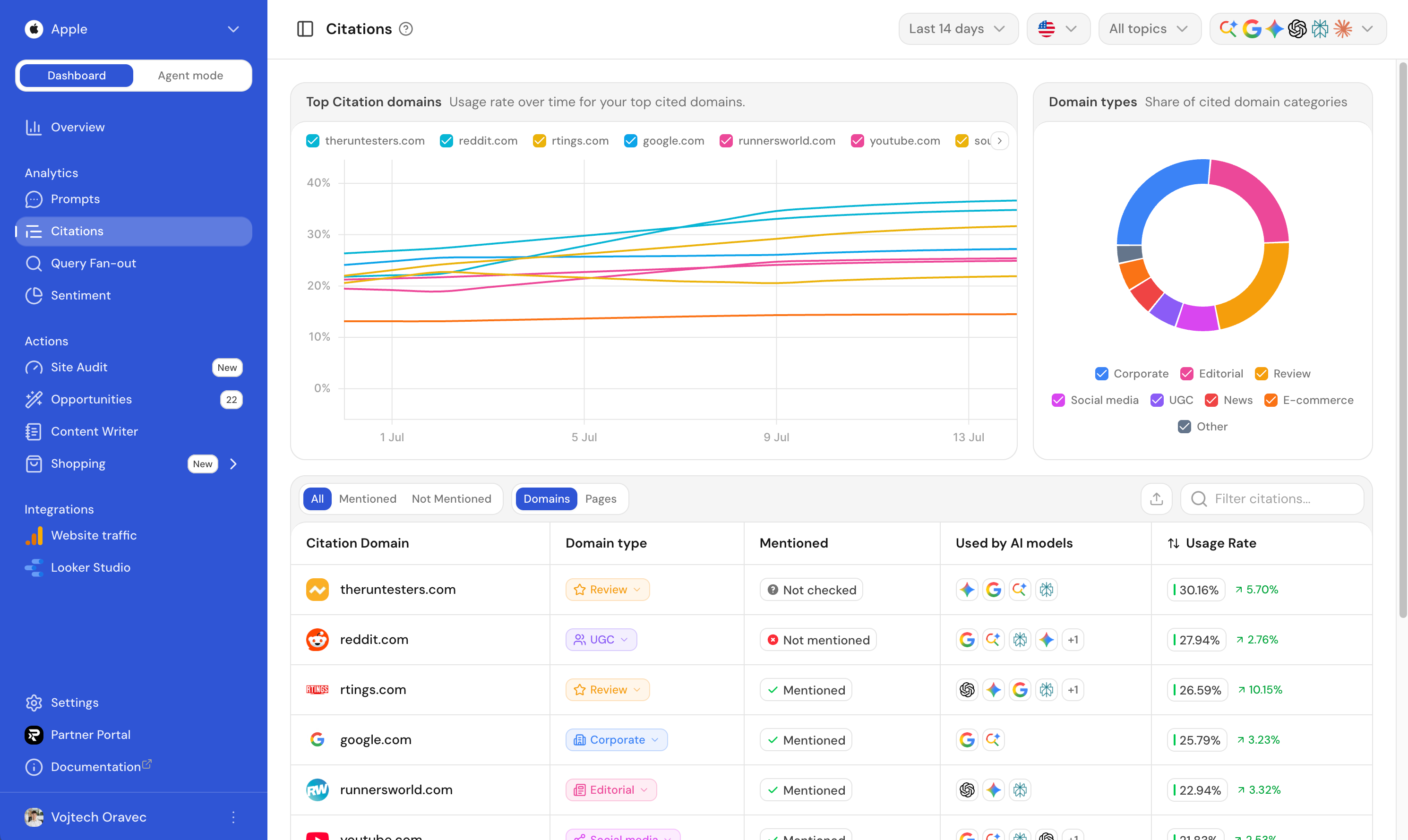
The Citations page shows which domains and URLs AI cites across your prompts. At the top you get:
- Top sources chart: usage rate over time for your most-cited domains or URLs
- Type share donut: how citations split across domain types or page types (click a segment to filter the table)
Switch between Domains and Pages to see aggregate domains or individual URLs. Expand a domain row to see the URLs cited under it.
Use the filters in the header (date range, country, topic, tags, provider) plus table controls for mentioned status and type filters.
Domain types
Describes who publishes the site:
| Type | Meaning |
|---|---|
| Corporate | Official brand or company site |
| UGC | User-generated content (forums, Q&A) |
| Editorial | Independent blogs, magazines, publications |
| Review | Review and comparison hubs (G2, Trustpilot, …) |
| Institutional | Government, academic, NGO (.gov, .edu, …) |
| Social media | Social and creator platforms |
| E-commerce | Marketplaces and third-party retail |
| Wiki | Encyclopedic wikis |
| News | News outlets and wire services |
| Other | Does not fit the types above |
Page types
Describes what kind of page was cited (Pages view):
| Type | Meaning |
|---|---|
| Landing page | General marketing or home page |
| Blog post | Article or editorial post |
| Press release | Official company announcement |
| Guide | How-to or tutorial |
| Listicle | Ranked or “best of” list |
| Comparison | Head-to-head comparison |
| Review | In-depth review of one product or brand |
| Product page | Single SKU or service detail page |
| Product category | Category or listing hub |
| Documentation | Docs or help content |
| Data report | Research or data-heavy report |
| Other | Does not fit the types above |
A domain can appear with multiple domain types when different URLs on that domain classify differently.
Key metrics
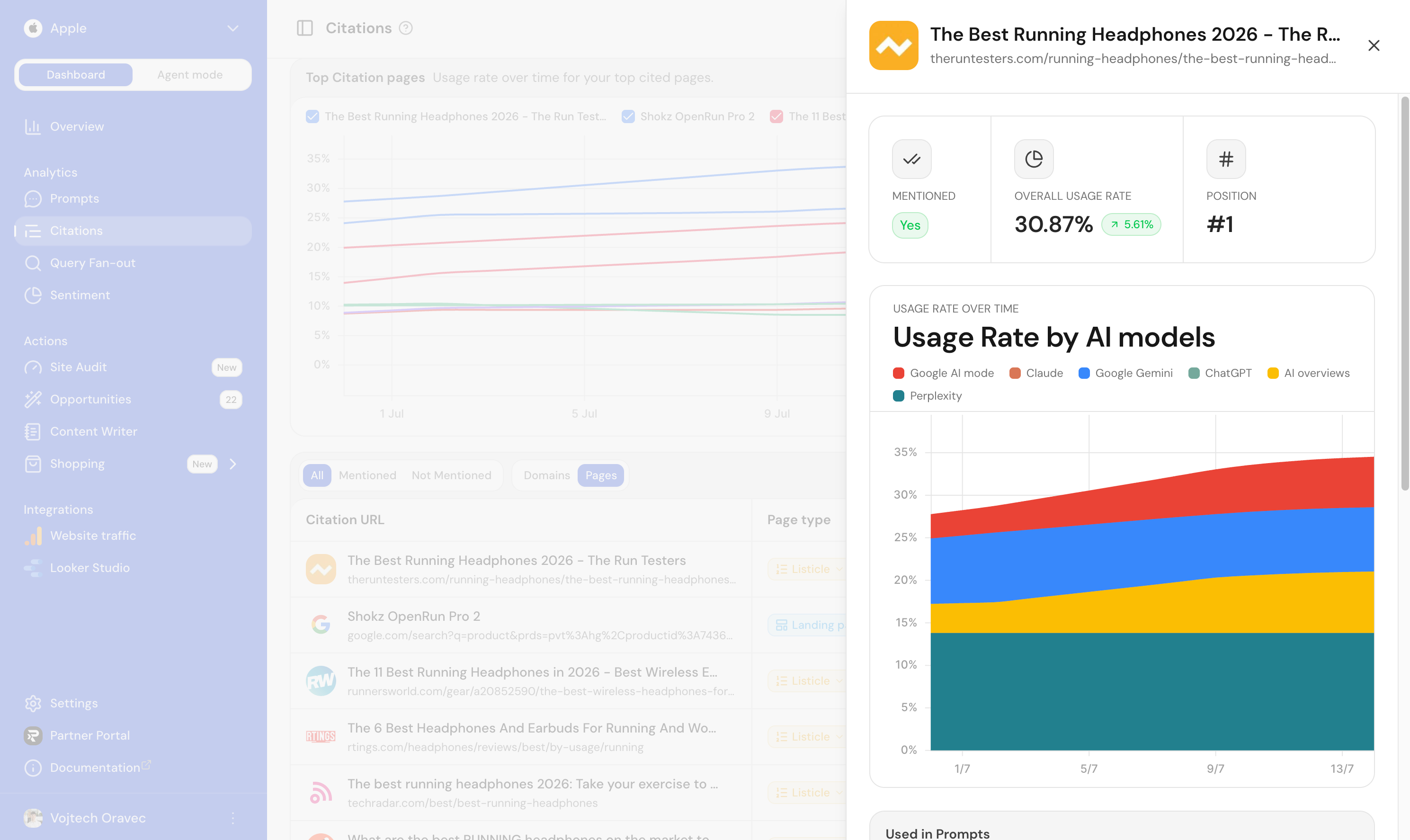
Usage rate: Percentage of completions in the selected period where AI cited that domain or URL. This is the main number in the table and charts.
Mentioned: Whether your brand was explicitly mentioned in completions that used that source. Being cited is good; being mentioned is better.
Share of voice: Your share of the answer space when AI responds. See Share of Voice >
How to use citation data
- Identify top sources: See which domains and page types AI cites most; aim to earn citations there or create similar content
- Filter by type: Use the donut or type filters to focus on editorial, UGC, product pages, etc.
- Benchmark competitors: Compare your usage rate and mention rate to competitors’ domains
- Find gaps: Prompts where competitors are cited but you are not
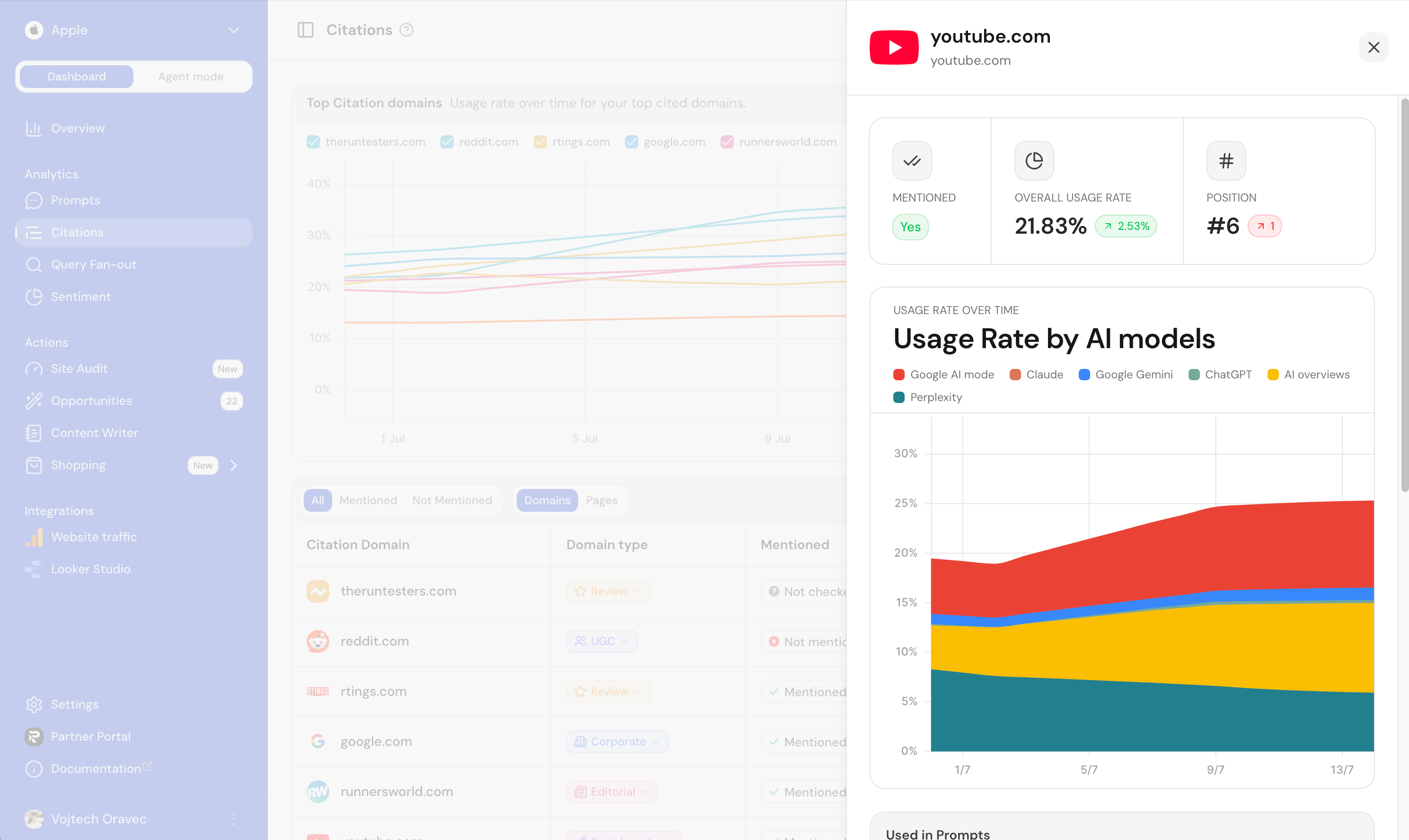
- Drill into URLs: Open a domain or URL from the table for usage-over-time charts and per-prompt breakdown
Citation trends
Track citation data over time to see:
- Whether your usage rate on key domains is growing
- How new content affects which page types get cited
- Seasonal or event-driven changes in source mix
The same classification and filters apply on the prompt citations tab for a single prompt.
FAQ
Does a high usage rate for a domain guarantee my brand gets mentioned?
No. Usage rate only tells you how often AI cited that domain or URL. Whether your brand was explicitly mentioned in those completions is tracked separately as "Mentioned." Being cited is good, being mentioned is better.
Can the same URL be classified with more than one page type?
Each URL gets a single page type. A domain overall can still show multiple page types, and even multiple domain types, since it typically hosts different kinds of pages across its URLs.
Share of Voice
Share of voice measures your portion of the answer space when AI responds, your weighted share when you appear alongside competitors.
Site Audit
Site Audit scores every page on your site for technical SEO, content quality, and AEO (Answer Engine Optimization), so you know exactly what's holding a page back from being cited or recommended by AI.