

Share of Voice
Share of voice = (Σ(1/N per response where you appear) / total responses) × 100, where N = number of brands in that response
How it works
For each AI answer, we count how many brands are mentioned. If you're one of 5 brands in an answer, you get 1/5 of that answer's "voice." We sum this across all answers and express it as a percentage (0–100%). Compare yourself to competitors.
How it differs from visibility
- Visibility: Percentage of responses where you appear at all (binary: in or out).
- Share of voice: Your weighted share when you do appear, penalized if you're one of many brands in the same response.
You can have high visibility but low share of voice if you're often mentioned alongside many competitors.
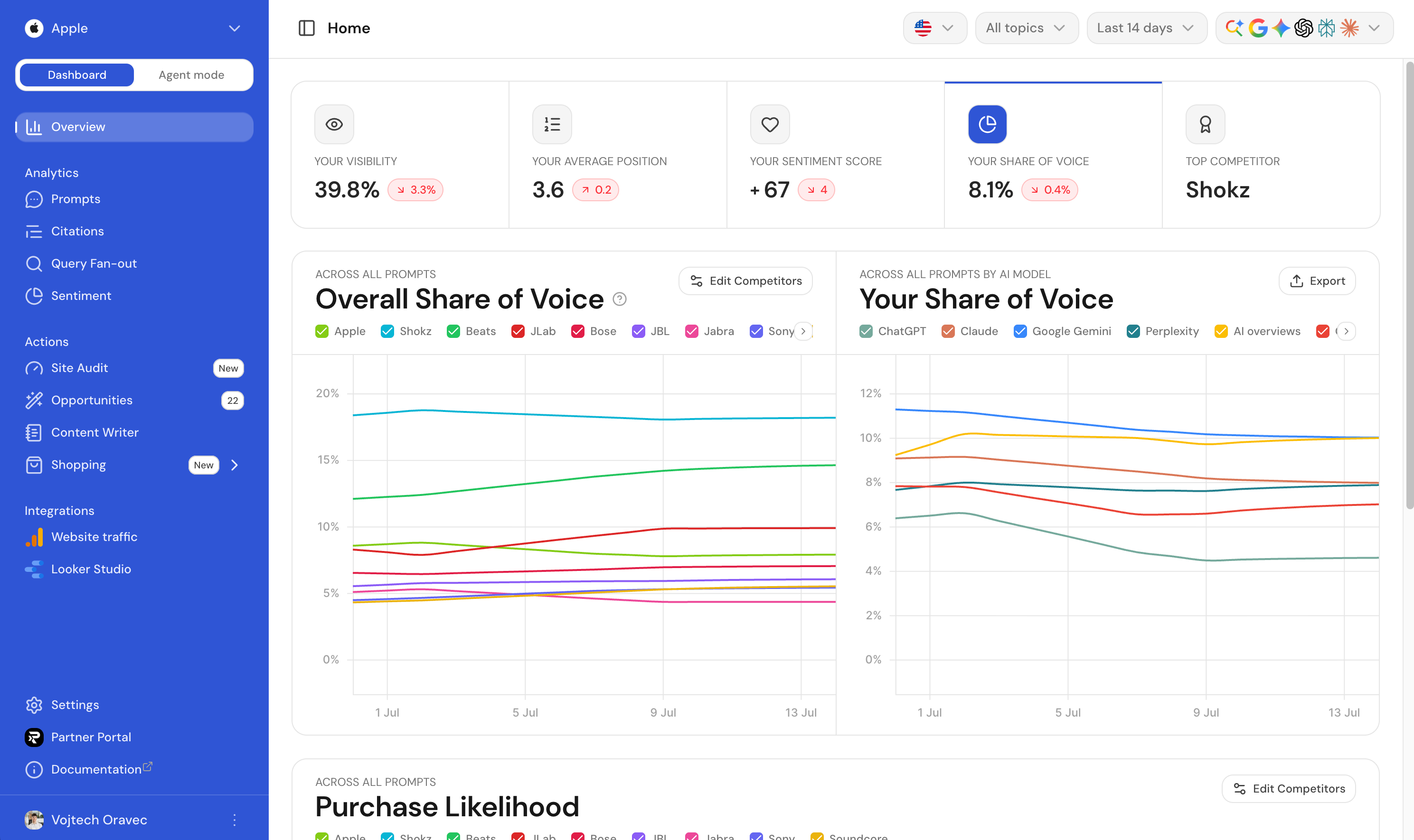
Viewing share of voice in Ranketta
- Per prompt: Share of voice for each prompt over time
- By platform: Share of voice across ChatGPT, Perplexity, and others
- By competitor: Compare your share vs. competitors
FAQ
Why is my share of voice lower than my visibility?
Visibility is binary, you either appear in an answer or you don't. Share of voice is a weighted share that gets penalized when you appear alongside many other brands in the same answer. So you can show up often (high visibility) but only claim a small slice each time (lower share of voice).
Is share of voice a better metric than visibility for comparing myself to competitors?
Share of voice accounts for competitive crowding, so it can give a more precise picture of your standing when several brands appear together. Visibility is still worth watching on its own, since it tells you whether you're in the conversation at all before worrying about how much of it you own.
Sentiment Score
The sentiment score runs from -100 to 100. Zero is neutral, 100 is positive, and -100 is negative. Higher is better.
Understand Citations
Citations are the sources AI references when answering prompts. Ranketta classifies them by publisher and page format so you can see which sources matter.